
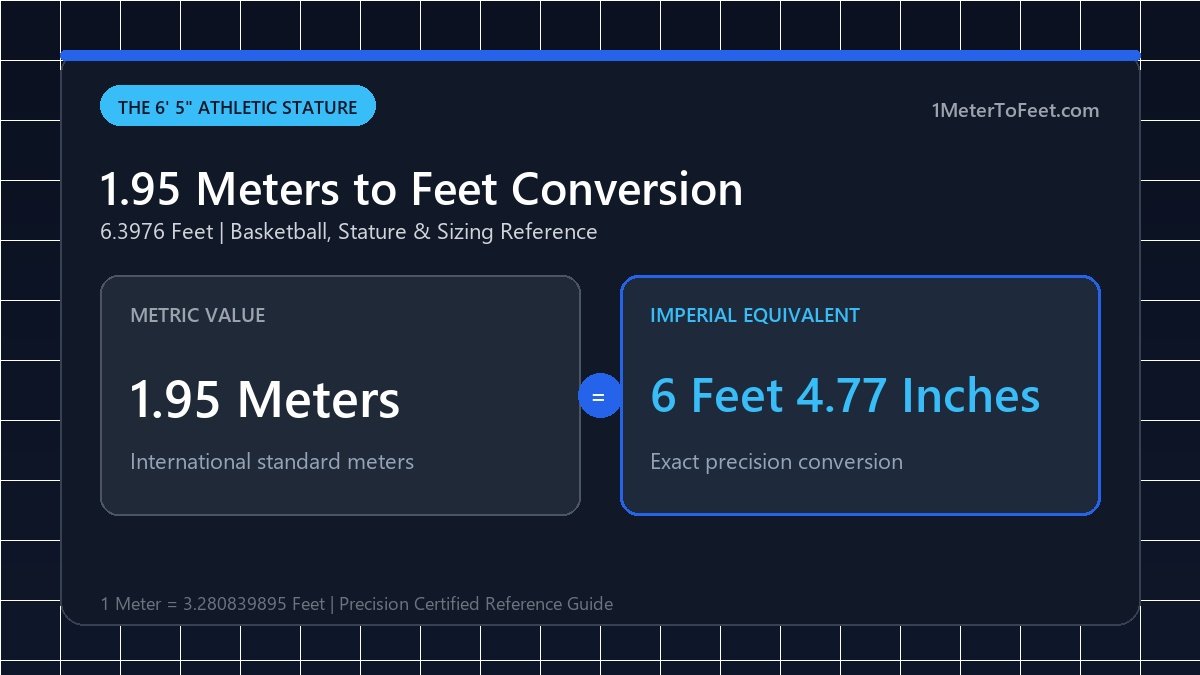
Converting 1.95 meters to feet yields exactly 6.3976 feet, which corresponds to 6 feet 4.77 inches (practically 6 feet 5 inches, or 195 centimeters). In total inches, 1.95 meters represents 76.77 inches. Because 1.95 meters sits within a quarter of an inch from exactly 6 feet 5 inches, it is one of the most widely looked up stature conversions on the internet, frequently searched by athletes, scouts, recruiters, and fashion consumers.
In competitive sports demographics, 1.95 meters represents an iconic milestone. It is widely considered the ideal height for basketball shooting guards and wing players, volleyball spikers, tennis power-servers, and American football quarterbacks. Stature measuring 195 cm combines exceptional reach and high-angle vantage points with agile footwork, making it a highly desirable physical profile across professional athletics.
Quick Conversion Reference: 1.95 Meters in Height Units
Decimal Feet: 6.3976 feet
Customary Height: 6 feet 4.77 inches (practically 6 feet 5 inches)
Total Inches: 76.77 inches
Centimeters: 195 cm
Millimeters: 1,950 mm
Distance from Exactly 6′ 5″: Minus 0.23 inches (-5.8 mm)
The Mathematical Formula for 1.95 Meters to Feet
Every standard conversion from metric meters to imperial feet uses the internationally standardized ratio 3.280839895. This multiplier originates from the 1959 international agreement that legally defined one imperial foot as exactly 0.3048 meters. To determine how many feet are in 1.95 meters, multiply 1.95 by this standardized constant.
Formula: Feet = Meters x 3.280839895
Calculation: Feet = 1.95 x 3.280839895 = 6.3976378 feet
To convert this decimal result into traditional feet and inches, keep 6 as the whole number of feet. Multiplying the remaining decimal portion of 0.3976378 feet by 12 inches per foot results in 4.77165 inches, which rounds cleanly to 4.77 inches (or 4 and 3/4 inches). Since 4.77 inches is less than a quarter of an inch below 5 inches, an individual measuring 1.95 meters barefoot comfortably clears 6 feet 5 inches in ordinary athletic shoes. To review decimal conversion mechanics and linear rules, explore our complete conversion methodology guide.
Comparative Height Table Around 1.95 Meters
Examining minor millimeter-level height variations around 195 centimeters is especially valuable for athlete scouting combines, modeling agency books, and tall apparel tailoring. The table below outlines height values spanning from 1.93 meters to 1.98 meters.
| Meters (m) | Centimeters (cm) | Decimal Feet | Feet and Inches |
|---|---|---|---|
| 1.93 m | 193 cm | 6.3320 ft | 6 ft 3.98 in (6′ 4″) |
| 1.94 m | 194 cm | 6.3648 ft | 6 ft 4.38 in |
| 1.95 m | 195 cm | 6.3976 ft | 6 ft 4.77 in (6′ 5″) |
| 1.96 m | 196 cm | 6.4304 ft | 6 ft 5.17 in |
| 1.98 m | 198 cm | 6.4961 ft | 6 ft 5.95 in (6′ 6″) |
Global Demographics: The Elite 99th Percentile Stature
From an international demographic perspective, standing 1.95 meters places an individual in an elite demographic bracket. For adult men globally, 1.95 meters falls into the 99.8th percentile, meaning fewer than two out of every one thousand men worldwide reach this stature. Even in the nations with the tallest average populations such as the Netherlands, Montenegro, and Bosnia where average male height sits near 1.83 meters (6 feet), standing 1.95 meters places an individual well into the top two percent of the populace. For women, 1.95 meters is extraordinarily rare, occurring in less than one in ten thousand individuals.
In basketball, iconic players such as Michael Jordan and Kobe Bryant were listed at 6 feet 6 inches in shoes, possessing barefoot measurements right around 1.95 to 1.96 meters. To compare this athletic benchmark with neighboring heights, review our profiles on the classic 1.90 meters guide as well as the tall stature analysis in our 1.88 meters height profile.
Everyday Clothing, Vehicle Comfort, and Ergonomic Clearance
Living at 1.95 meters requires thoughtful ergonomic adaptation. Standard interior doorways constructed at 6 feet 8 inches (2.03 meters) leave just 3 to 4 inches of clearance, meaning tall individuals frequently duck slightly when wearing shoes. In automotive travel, vehicles without adjustable seat-height tracks or sunroofs can restrict headroom, making full-size sedans and SUVs preferred choices. In apparel, adults measuring 195 cm require specialized tall or extra-tall sizing, requiring trousers with an inseam of 34 to 36 inches and sleeves with extended wrist drops.
For immediate conversion calculations across medical records, athletic profiling, and architectural dimensions, use our main conversion calculator. You can also explore hundreds of comprehensive height and distance conversions in our meter to feet category archive.