
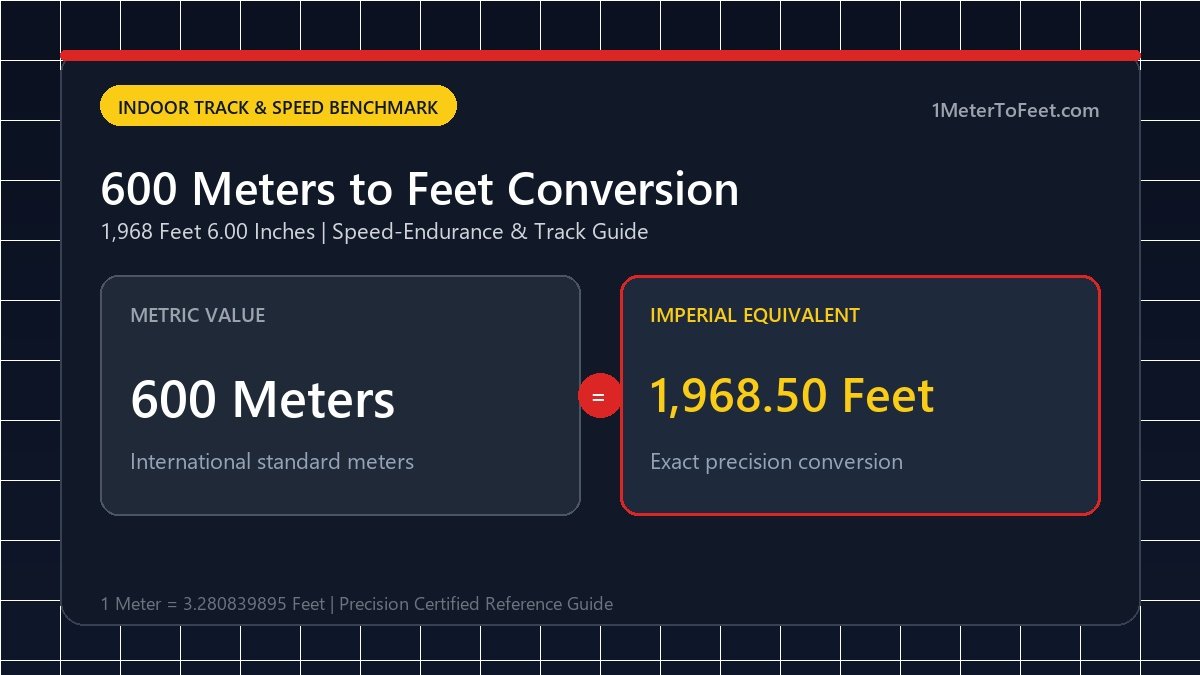
Converting 600 meters to feet yields exactly 1,968.50 feet, which translates into customary imperial measurements as 1,968 feet and 6.05 inches. In terms of larger linear and sports measurements, 600 meters equals precisely 0.6 kilometers, approximately 0.37282 miles, or 656.17 yards. The six-hundred-meter distance represents a premier benchmark in track and field athletics, serving as the definitive indoor middle-distance race that tests pure speed-endurance between sprinters and middle-distance specialists.
Beyond track running, six hundred meters represents a critical reference in commercial aviation approach minimums, marine shipping fairway visibility regulations, and drone visual line-of-sight legal boundaries. Converting this metric distance into customary imperial feet with mathematical precision allows athletic coaches, civil engineers, drone pilots, and surveyors to correlate spatial distances accurately across international measurement standards.
Quick Conversion Reference: 600 Meters in Imperial Units
Decimal Feet: 1,968.50 feet (rounded to two decimal places)
Feet and Inches: 1,968 feet 6.05 inches (effectively 1,968 feet 6 inches)
Total Inches: 23,622.05 inches
Total Yards: 656.17 yards
Total Miles: 0.37282 miles
Track Context: Exactly 1.5 laps of an outdoor 400m track or 3 laps of a 200m indoor track
The Mathematical Formula for 600 Meters to Feet
Every standard metric-to-imperial linear conversion is established upon the international yard agreement of 1959, which defines one imperial foot as exactly 0.3048 meters. The reciprocal of 0.3048 provides the standard conversion factor of 3.280839895013123. To calculate the total number of feet in 600 meters, multiply six hundred by this standardized multiplier.
Formula: Feet = Meters x 3.280839895
Calculation: Feet = 600 x 3.280839895 = 1,968.503937 feet
To break this value into traditional feet and fractional inches, separate the integer foot component from the remaining decimal portion. The integer portion gives 1,968 feet. Multiplying the remaining fractional part of 0.503937 feet by 12 produces 6.0472 inches, which rounds cleanly to 6.05 inches (essentially 6 inches). For foundational mathematical derivations and conversion guidelines, explore our complete conversion methodology guide.
Detailed Conversion Table Around 600 Meters
Athletes monitoring sprint splits, marine navigators calculating fairway clearance, and property developers setting buffer zones frequently require reference points around six hundred meters. The table below outlines adjacent metric benchmarks alongside their exact decimal feet and customary imperial equivalents.
| Meters (m) | Decimal Feet (ft) | Feet and Inches | Application & Context |
|---|---|---|---|
| 500 m | 1,640.42 ft | 1,640 ft 5.04 in | Rowing sprint split interval |
| 550 m | 1,804.46 ft | 1,804 ft 5.54 in | Intermediate interval interval marker |
| 600 m | 1,968.50 ft | 1,968 ft 6.05 in | Standard indoor track 600m event |
| 650 m | 2,132.55 ft | 2,132 ft 6.55 in | Outdoor track breakaway point |
| 700 m | 2,296.59 ft | 2,296 ft 7.06 in | 800m penultimate lap marker |
Athletic Significance: The Indoor 600m Speed-Endurance Benchmark
In competitive athletics, 600 meters requires exactly three complete laps around a standard 200-meter banked indoor running track, or one and a half laps around a regulation 400-meter outdoor track. This event represents a unique physiological battleground: pure 400-meter sprinters attempt to stretch their anaerobic capacity to 600 meters, while 800-meter specialists test their top-end speed over a shorter course. Elite male athletes complete this 1,968.5-foot distance in under 1 minute and 14 seconds, while world-class female athletes finish in under 1 minute and 24 seconds.
Coaches structuring sprint progression frequently connect interval workouts between our standard outdoor lap reference in the 400 meters guide and the full two-lap aerobic distance analyzed in the 800 meters guide.
Real-World Engineering, Aviation, and Regulatory Applications
Outside the running track, 600 meters represents a standard regulatory benchmark in modern transportation and civil planning. In aviation, 600 meters (roughly 1,969 feet) defines the standard runway visual range threshold for Category I instrument flight rule approaches. In uncrewed aerial vehicle operations, aviation authorities specify 500 to 600 meters as the practical limit for unaided visual line of sight. In telecommunications and urban utility layout, 600 meters serves as the standard spacing interval between optical fiber distribution nodes.
To calculate immediate linear conversions across civil engineering, athletic pacing, and spatial planning, use our universal conversion calculator. You can also explore dozens of comprehensive height and distance benchmarks in our meter to feet category archive.