
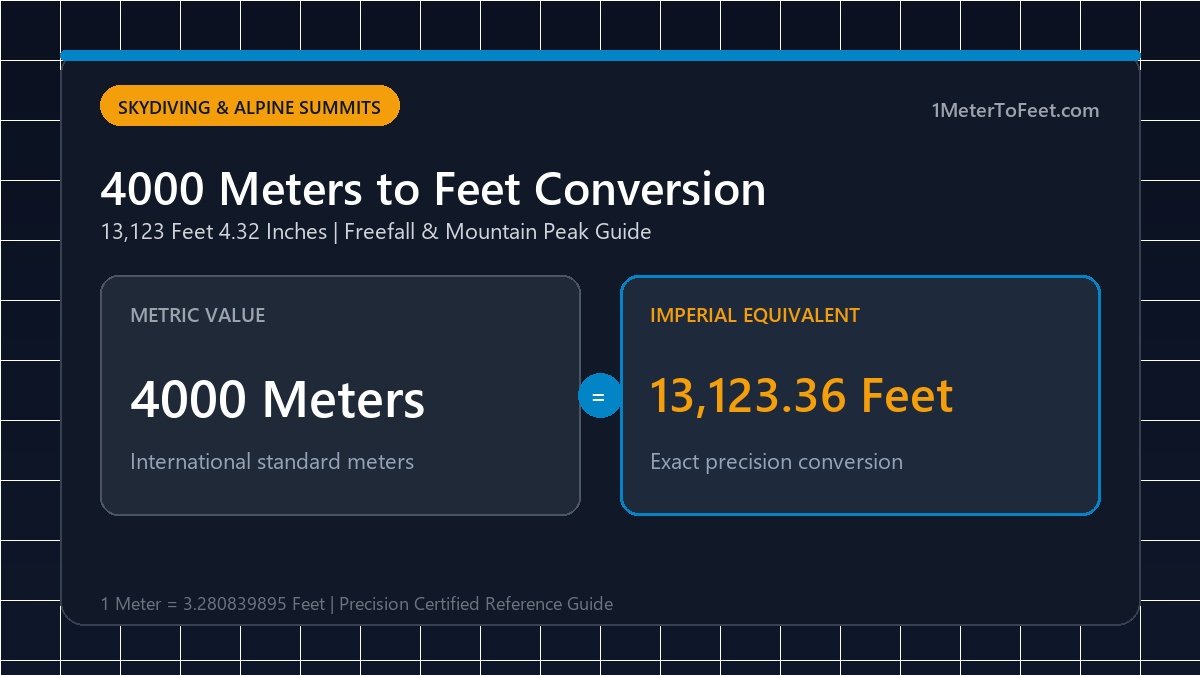
Converting 4000 meters to feet yields exactly 13,123.36 feet, which translates into customary imperial measurements as 13,123 feet and 4.32 inches. In terms of larger sports, aviation, and geographical units, 4000 meters equals precisely 4 kilometers, approximately 2.48548 miles, or 4,374.45 yards. The four-thousand-meter threshold represents one of the most prominent operational milestones in skydiving, high-altitude mountaineering, and track cycling.
In commercial skydiving, 4000 meters (roughly 13,000 feet) serves as the universally recognized standard exit altitude for tandem and sports skydives, offering approximately 60 full seconds of adrenaline-fueled freefall at terminal velocity before parachute deployment. In mountaineering geography, 4000 meters defines the legendary “Four-Thousanders” of the European Alps, encompassing iconic peaks like Mont Blanc, the Matterhorn, and the Monte Rosa massif. Converting 4000 meters into customary feet provides critical operational context for skydivers, mountaineers, and endurance athletes.
Quick Conversion Reference: 4000 Meters in Imperial Units
Decimal Feet: 13,123.36 feet (rounded to two decimal places)
Feet and Inches: 13,123 feet 4.32 inches
Total Inches: 157,480.31 inches
Total Yards: 4,374.45 yards
Total Miles: 2.48548 miles (approximately 2.49 miles)
Operational Context: Worldwide Standard Skydiving Exit Altitude (13,000 ft AGL)
The Mathematical Formula for 4000 Meters to Feet
The standard linear conversion constant connecting metric meters to imperial feet is 3.280839895013123. This value originates from the international yard agreement of 1959, which legally established one imperial foot as exactly 0.3048 meters. To calculate how many feet are in 4000 meters, multiply four thousand by this standardized multiplier.
Formula: Feet = Meters x 3.280839895
Calculation: Feet = 4000 x 3.280839895 = 13,123.35958 feet
To convert this decimal result into traditional feet and inches, keep 13,123 as the whole number of feet. Multiplying the remaining decimal fraction of 0.35958 feet by 12 inches per foot yields 4.3150 inches, which rounds to 4.32 inches. For comprehensive conversion formulas and calculation methodologies, explore our complete conversion methodology guide.
Detailed Conversion Table Around 4000 Meters
Skydivers calculating jump clearances, mountain climbers mapping summit routes, and atmospheric scientists measuring barometric layers frequently require intermediate benchmarks around four kilometers. The table below outlines adjacent metric benchmarks alongside their exact decimal feet and customary imperial equivalents.
| Meters (m) | Decimal Feet (ft) | Feet and Inches | Application & Context |
|---|---|---|---|
| 3,800 m | 12,467.19 ft | 12,467 ft 2.30 in | Lake Titicaca surface elevation |
| 3,900 m | 12,795.28 ft | 12,795 ft 3.31 in | High Andean plateau staging area |
| 4,000 m | 13,123.36 ft | 13,123 ft 4.32 in | Standard skydiving exit altitude & 4K Alpine summit |
| 4,100 m | 13,451.44 ft | 13,451 ft 5.33 in | Barre des Ecrins summit altitude |
| 4,200 m | 13,779.53 ft | 13,779 ft 6.33 in | Grandes Jorasses ridge summit |
Skydiving Operations and Atmospheric Physiology at 13,100 Feet
In aviation and parachute sports, 4000 meters above ground level represents the golden standard for drop zone operations. Jump aircraft such as the Cessna Caravan, Super Otter, and PAC 750XL climb to 4,000 meters in approximately 12 to 15 minutes. At 13,123 feet, ambient air density is approximately 63 percent of sea level, allowing jumpers to reach speeds of roughly 120 miles per hour (193 kilometers per hour) in belly-to-earth orientation before opening their main parachutes at 3,000 to 4,000 feet above the ground.
In athletics and track cycling, 4000 meters serves as the standard distance for the Olympic Team Pursuit event, where four-rider teams race 16 laps around a 250-meter velodrome at speeds exceeding 60 kilometers per hour. For runners and climbers analyzing elevation stages, coaches bridge altitude pacing between our 3000 meters alpine guide and the major international road race benchmark detailed in the 5000 meters distance guide.
High Alpine Geography: The Alpine Four-Thousanders
In European mountaineering, summits exceeding 4,000 meters carry legendary prestige. The International Climbing and Mountaineering Federation officially recognizes 82 distinct summits exceeding 4000 meters in the Alps, including the Matterhorn at 4,478 meters and Mont Blanc at 4,808 meters. Above 13,123 feet, glaciers remain permanently frozen year-round, and severe alpine weather conditions can develop rapidly with sudden temperature drops.
To convert any measurement instantly across aeronautics, alpine exploration, and sports analytics, use our main conversion calculator. You can also explore dozens of comprehensive height and distance benchmarks in our meter to feet category archive.