
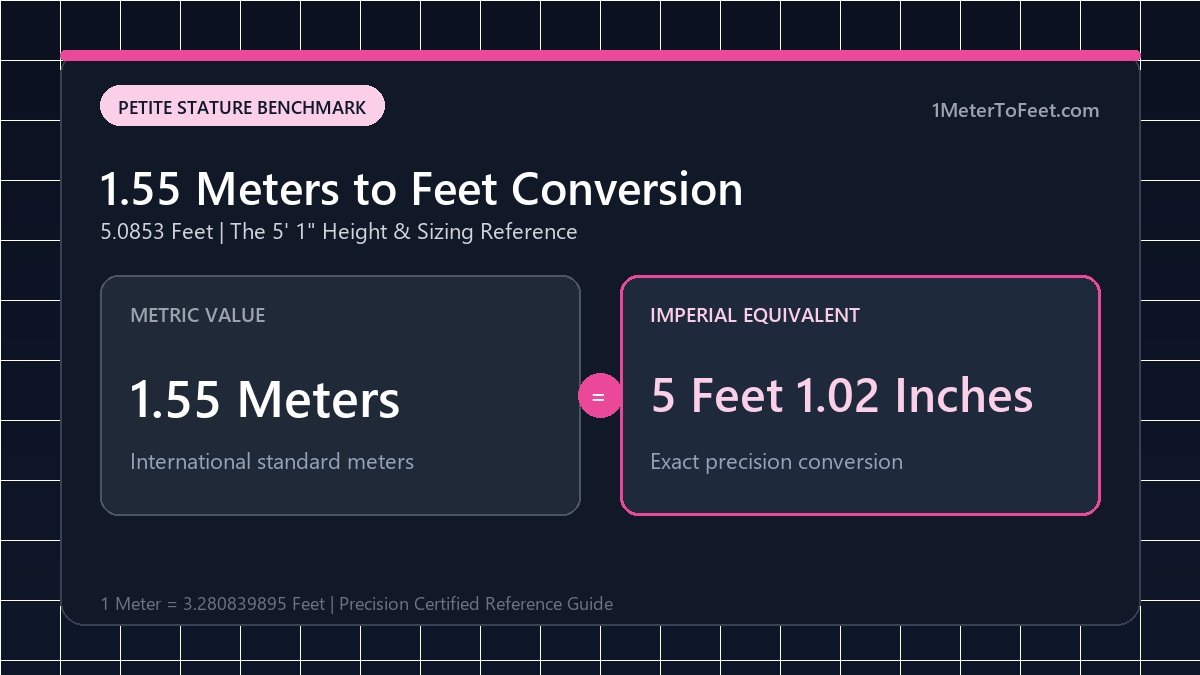
Converting 1.55 meters to feet yields exactly 5.0853 feet, which equals 5 feet 1.02 inches (practically 5 feet 1 inch, or 155 centimeters). In total inches, 1.55 meters represents 61.02 inches. Because 1.55 meters sits just 0.02 inches over exactly 5 feet 1 inch, it represents one of the cleanest round-number conversions in human stature profiling.
Globally, 1.55 meters represents an important demographic baseline. It is the national average adult female height in multiple Latin American and Southeast Asian countries, as well as the standard entry point for petite apparel sizing across North America and Europe. Understanding how 1.55 meters converts into customary feet and inches provides immediate clarity for anyone comparing medical health records, fashion fit guides, or vehicle seating adjustments.
Quick Conversion Reference: 1.55 Meters in Height Units
Decimal Feet: 5.0853 feet
Customary Height: 5 feet 1.02 inches (effectively 5 feet 1 inch)
Total Inches: 61.02 inches
Centimeters: 155 cm
Millimeters: 1,550 mm
Distance from Exactly 5′ 1″: Plus 0.02 inches (+0.6 mm)
The Mathematical Formula for 1.55 Meters to Feet
The standard conversion factor connecting meters to feet is 3.280839895, based upon the 1959 international definition that establishes one imperial foot as exactly 0.3048 meters. To calculate how many feet are in 1.55 meters, multiply 1.55 by this universal multiplier.
Formula: Feet = Meters x 3.280839895
Calculation: Feet = 1.55 x 3.280839895 = 5.0853018 feet
To express this decimal calculation in customary feet and inches, keep 5 as the whole number of feet. Multiplying the remaining fractional portion of 0.0853018 feet by 12 inches per foot results in 1.0236 inches. Rounding to the nearest eighth of an inch gives 5 feet 1 inch. For comprehensive conversion formulas and calculation methodologies, explore our complete conversion methodology guide.
Comparative Height Table Around 1.55 Meters
Examining minor millimeter-level height variations around 155 centimeters is especially helpful for garment pattern grading, athletic weight divisions, and petite retail specifications. The table below presents measurements spanning from 1.53 meters to 1.58 meters.
| Meters (m) | Centimeters (cm) | Decimal Feet | Feet and Inches |
|---|---|---|---|
| 1.53 m | 153 cm | 5.0197 ft | 5 ft 0.24 in (5′ 0″) |
| 1.54 m | 154 cm | 5.0525 ft | 5 ft 0.63 in |
| 1.55 m | 155 cm | 5.0853 ft | 5 ft 1.02 in (5′ 1″) |
| 1.56 m | 156 cm | 5.1181 ft | 5 ft 1.42 in |
| 1.57 m | 157 cm | 5.1509 ft | 5 ft 1.81 in |
Global Demographics and Athletic Stature
In global demographic analyses, 1.55 meters represents the exact median height for adult women in nations such as Guatemala, the Philippines, Indonesia, Peru, and Vietnam. In North America and the United Kingdom where average female height is 1.63 meters (5 feet 4 inches), an adult female measuring 1.55 meters falls into the 15th to 20th percentile of population height.
In athletic disciplines, individuals measuring 5 feet 1 inch frequently enjoy superior rotational mechanics, a low center of gravity, and an advantageous strength-to-weight ratio. These traits provide significant competitive advantages in artistic gymnastics, figure skating, horse racing as professional jockeys, and competitive cheerleading. To compare this petite benchmark with taller stature guides, explore our 1.60 meters height guide as well as the average female standard in our 1.63 meters profile.
Everyday Clothing, Ergonomics, and Vehicle Adjustments
Living at 1.55 meters presents unique ergonomic considerations. Standard kitchen counters and bathroom vanities designed at 36 inches (91 cm) in height may require small platform steps for optimal leverage during meal preparation. In office settings, setting an ergonomic chair so the seat pan rests approximately 15 to 16 inches from the floor, combined with an under-desk footrest, ensures proper posture without thigh pressure. In apparel, women measuring 155 cm typically select specialized petite cuts, where sleeve lengths, torso proportions, and pant inseams (typically 26 to 28 inches) are tailored to prevent bunching.
For accurate conversion calculations across all medical measurements, architectural floor plans, and travel documents, use our universal meter conversion calculator. You can also explore numerous stature and distance benchmarks in our meter to feet category archive.