
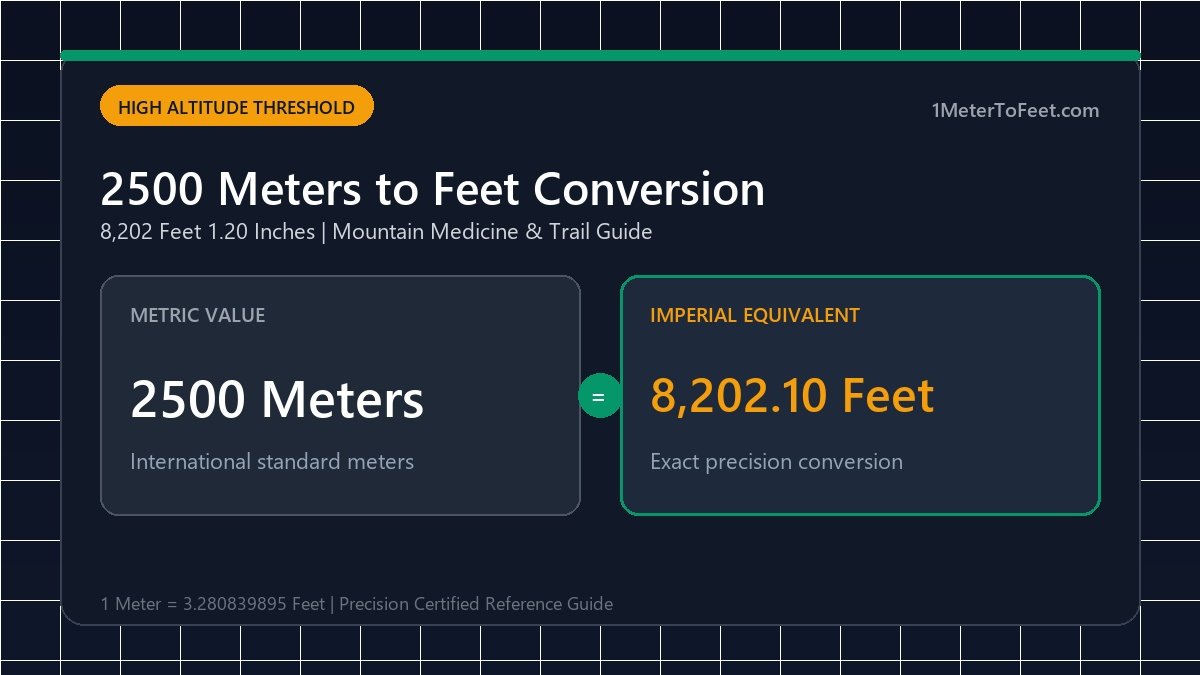
Converting 2500 meters to feet yields exactly 8,202.10 feet, which translates into 8,202 feet and 1.20 inches. In larger sports and geographical units, 2500 meters equals precisely 2.5 kilometers, approximately 1.55343 miles, or 2,734.03 yards. The twenty-five-hundred-meter distance represents a monumental benchmark in environmental physiology, sports science, and high-altitude geography.
In wilderness medicine and mountaineering guidelines, 2500 meters (roughly 8,200 feet) marks the globally recognized medical threshold where the physiological definition of High Altitude begins. Above 2,500 meters, atmospheric pressure drops to approximately 74 percent of sea level, and travelers become susceptible to Acute Mountain Sickness (AMS). Understanding this conversion with mathematical precision provides essential clarity for alpine hikers planning acclimatization stops, endurance athletes analyzing mountain trails, and civil surveyors designing mountain infrastructure.
Quick Conversion Reference: 2500 Meters in Imperial Units
Decimal Feet: 8,202.10 feet (rounded to two decimal places)
Feet and Inches: 8,202 feet 1.20 inches
Total Inches: 98,425.20 inches
Total Yards: 2,734.03 yards
Total Miles: 1.55343 miles (approximately 1.55 miles)
Scientific Notation: 8.20210 x 10^3 feet
The Mathematical Formula for 2500 Meters to Feet
Every standard conversion from metric meters into imperial feet relies on the universal conversion constant 3.280839895. This value originates from the 1959 international standards agreement, which established that one imperial foot contains exactly 0.3048 meters. To determine how many feet are in 2500 meters, multiply two thousand five hundred by this standardized factor.
Formula: Feet = Meters x 3.280839895
Calculation: Feet = 2500 x 3.280839895 = 8,202.0997 feet
To express this decimal outcome in customary feet and inches, keep 8,202 as whole feet. Taking the remaining decimal fraction of 0.0997 feet and multiplying by 12 inches per foot produces 1.1969 inches, which rounds cleanly to 1.20 inches. For a thorough review of linear conversion principles and calculation methodologies, visit our complete conversion methodology guide.
Detailed Conversion Table Surrounding 2500 Meters
Mountain climbers planning elevation gains, trail runners calculating race profiles, and civil engineers planning road gradients frequently require incremental benchmarks around two and a half kilometers. The table below outlines adjacent metric benchmarks alongside their exact decimal feet and customary imperial equivalents.
| Meters (m) | Decimal Feet (ft) | Feet and Inches | Application & Context |
|---|---|---|---|
| 2,300 m | 7,545.93 ft | 7,545 ft 11.18 in | High plateau trail marker |
| 2,400 m | 7,874.02 ft | 7,874 ft 0.19 in | Pre-altitude staging contour |
| 2,500 m | 8,202.10 ft | 8,202 ft 1.20 in | Medical high-altitude threshold & 2.5K split |
| 2,600 m | 8,530.18 ft | 8,530 ft 2.21 in | Bogota, Colombia urban elevation benchmark |
| 2,700 m | 8,858.27 ft | 8,858 ft 3.22 in | Alpine ski pass summit station |
Medical and Environmental Context: The High-Altitude Boundary
In environmental medicine, the 2,500-meter mark is recognized by the Wilderness Medical Society, the Centers for Disease Control and Prevention, and the World Health Organization as the formal dividing line between moderate elevation and true high altitude. Above 8,200 feet, the barometric pressure drops from 101.3 kilopascals to approximately 74 kilopascals. This reduction diminishes the partial pressure of oxygen inspired into human lungs by roughly 26 percent, triggering hyperventilation, increased cardiac output, and fluid retention in unacclimatized travelers.
In cross-country athletics and trail running, 2500 meters represents six and a quarter laps on an outdoor track or a standard split in middle-distance cross-country races. Coaches regularly connect altitude training pacing between our 2000 meters guide and the steeper oxygen-deprived stages examined in our 3000 meters alpine guide.
Everyday Calculation and Engineering Applications
When calculating 2500 meters into imperial feet on the trail without a calculator, mental estimation is straightforward. Taking 2,500 multiplied by three produces 7,500 feet. Adding ten percent of that figure (750 feet) gives 8,250 feet, which is within less than one percent of the true 8,202.1-foot figure. This simple heuristic provides hikers and field engineers with an instant, reliable reference in remote locations.
To convert any measurement instantly across civil engineering, alpine exploration, and sports analytics, use our main conversion calculator. You can also explore dozens of comprehensive height and distance benchmarks in our meter to feet category archive.