
Quick Answer Summary
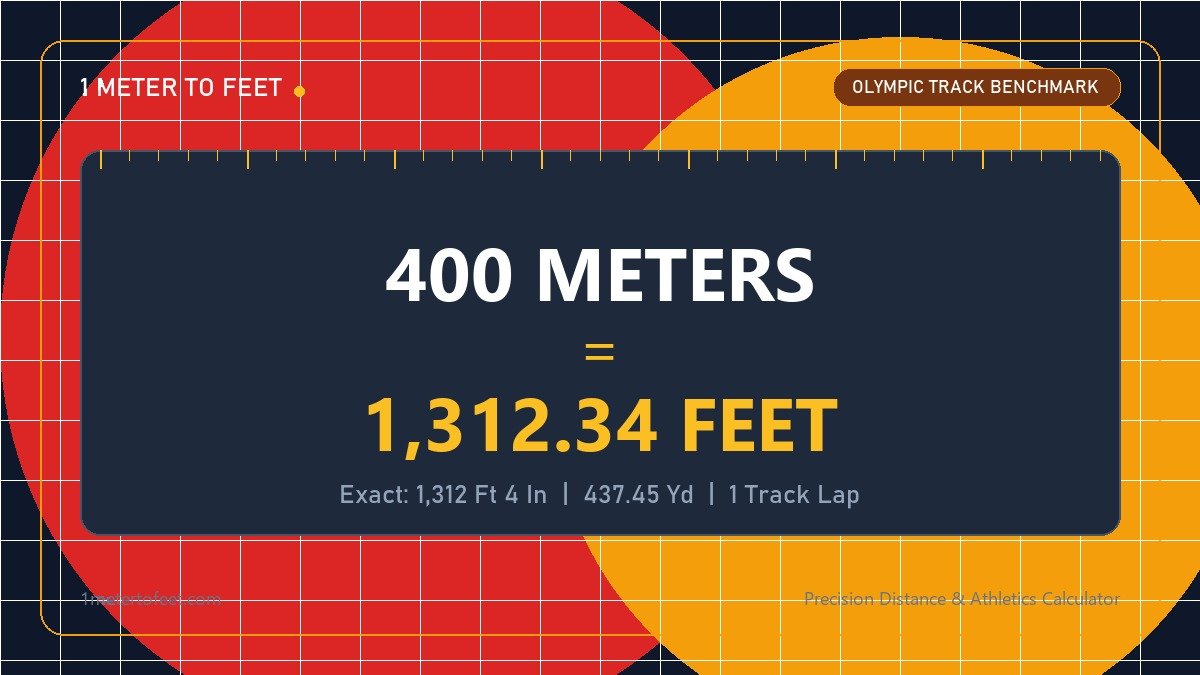
400 meters is equal to 1,312.3360 feet, which converts on an imperial track or field tape to 1,312 feet and 4.03 inches (or 1,312 feet 4 1/16 inches). In standard imperial track dimensions, 400 meters represents exactly one complete lap of an Olympic running track, which equals 437.45 yards (just 2.55 yards short of a classic quarter mile).
The mathematical equation used for this calculation is Feet = Meters × 3.28084. If you need to convert any other custom athletic track dimension, sprint distance, or field measurement instantly, use our free meters to feet online calculator for immediate results.
Introduction
Converting 400 meters into imperial feet is an essential calculation throughout track and field athletics, sports stadium architecture, high school and collegiate sports management, and athletic performance training. Under World Athletics regulations, standard international outdoor running tracks measure exactly 400 meters around Lane 1.
For athletes, coaches, and sports facility builders operating in the United States and the United Kingdom, translating metric track distances into imperial feet and yards is necessary for facility construction, pacing splits, and training calibrations. Below is an exhaustive breakdown of the mathematical derivation, fractional inch calculations, athletic track geometry, and comprehensive reference tables.
The Exact Mathematical Formula and Derivation
The relationship between the metric meter and the international imperial foot is defined by international treaty under the International Yard and Pound Agreement of 1959. This treaty legally established one international yard as exactly 0.9144 meters, making one foot equal to exactly 0.3048 meters.
Taking the reciprocal of 0.3048 meters produces the standard mathematical conversion factor:
Feet = Meters × 3.2808399
To convert any distance from meters into feet, multiply the meter measurement by 3.2808399. For a broader mathematical breakdown of conversion formulas, you can also consult our comprehensive guide on how to convert meters to feet.
Step-by-Step Calculation for 400 Meters
Applying the official international constant directly to 400 meters yields:
Feet = 400 × 3.280839895 = 1,312.335958 ft
In practical applications, this decimal value can be stated according to required precision standards:
For track design, laser timing systems, and facility engineering, the complete value of 1,312.3360 feet is preserved.
For coaching pacing charts and general sports documentation, the measurement is recorded to two decimal places as 1,312.34 feet.
For rough athletic field estimates, the figure is rounded to 1,312 feet.
Converting 400 Meters into Feet and Fractional Inches
Athletic construction tapes and field survey lines throughout North America divide measurements into whole feet, whole inches, and fractional divisions such as sixteenths or eighths of an inch.
To convert 1,312.3360 feet into a tape-readable format, first separate the whole number from the decimal. The whole integer represents 1,312 whole feet.
Next, take the remaining decimal fraction (0.335958 ft) and multiply it by 12, because there are 12 inches in a single foot:
0.335958 × 12 = 4.0315 inches
This calculation reveals that 400 meters equals 1,312 feet and approximately 4.03 inches.
Finally, multiply the remaining decimal of an inch (0.0315) by 16 to determine the nearest 16th of an inch. Because 0.0315 × 16 = 0.50, it represents less than a 16th of an inch.
Therefore, on a physical measuring tape, 400 meters reads cleanly as 1,312 feet and 4 inches (1,312′ 4″).
Athletic and Structural Perspective: How Long is 400 Meters?
Visualizing 400 meters against major athletic and architectural benchmarks highlights the scale of this distance:
In standard track geometry under World Athletics, a 400-meter track consists of two straightaways measuring 84.39 meters each and two semicircular curves with a radius of 36.50 meters. One full circuit around Lane 1 spans exactly 1,312.34 feet.
In comparison with American football fields, including both end zones, a regulation NFL field measures 360 feet (120 yards). A single lap of 400 meters (1,312.34 feet) is almost four times the entire length of an American football stadium.
In comparison with Olympic straightaway sprint tracks, a distance of 110 meters represents the standard hurdle race straightaway. 400 meters covers more than three and a half times that distance. To inspect sprint track comparisons, see our 110 meters to feet conversion guide.
In skyscraper architecture, 400 meters corresponds to the vertical roof height of iconic supertall skyscrapers like the original World Trade Center towers (417 meters / 1,368 feet) and the Empire State Building roof (381 meters / 1,250 feet). For related high-elevation benchmarks, check our 111 meters to feet guide.
Quick Mental Math Technique
When standing on a track without a calculator, you can estimate 400 meters by multiplying by 3.3.
First, multiply 400 by 3 to reach 1,200. Then multiply 400 by 0.3 to obtain 120. Summing 1,200 and 120 provides 1,320 feet. Subtracting approximately 7.7 feet to account for the slight overestimation of 3.3 compared to 3.28084 brings you to 1,312.3 feet, which is accurate to within a fraction of an inch.
Reverse Conversion: Converting 1,312.34 Feet to Meters
To verify calculations or convert imperial track measurements back into metric units, multiply the total foot measurement by 0.3048:
Meters = 1,312.3360 × 0.3048 = 400.0000 meters
This confirms that 1,312.34 feet converts exactly back to 400 meters.
Athletic Track Distance Comparison Reference Table
The following reference table outlines nearby metric race distances, decimal feet, fractional tape increments, and yard equivalents:
| Meters (m) | Decimal Feet (ft) | Feet & Inches | Yards (yd) | Athletic Event Context |
|---|---|---|---|---|
| 100 meters | 328.08 ft | 328 ft 1.01 in | 109.36 yd | Olympic sprint straightaway |
| 200 meters | 656.17 ft | 656 ft 2.02 in | 218.72 yd | Half lap of running track |
| 300 meters | 984.25 ft | 984 ft 3.02 in | 328.08 yd | Three-quarter track sprint |
| 400 meters | 1,312.34 ft | 1,312 ft 4.03 in | 437.45 yd | 1 complete track lap |
| 800 meters | 2,624.67 ft | 2,624 ft 8.06 in | 874.89 yd | 2 complete track laps |
| 1500 meters | 4,921.26 ft | 4,921 ft 3.12 in | 1,640.42 yd | Metric mile (3.75 laps) |
Frequently Asked Questions
How many feet are in 400 meters?
There are exactly 1,312.3360 international feet in 400 meters. For coaching and sports facility engineering, this is standardly recorded as 1,312.34 feet.
Is 400 meters equal to a quarter mile?
400 meters is very close to a quarter mile, but slightly shorter. A true quarter mile measures exactly 440 yards (1,320 feet), while 400 meters measures 437.45 yards (1,312.34 feet), making 400 meters approximately 7.66 feet (2.33 meters) shorter than a quarter mile.
How many laps of a running track is 400 meters?
On a standard outdoor running track built to World Athletics specifications, exactly one complete lap around Lane 1 measures 400 meters.
How many yards is 400 meters?
Because there are three feet in one yard, dividing 1,312.3360 by 3 yields approximately 437.45 yards.
What is the world record for running 400 meters?
The men’s 400-meter world record is 43.03 seconds, set by Wayde van Niekerk of South Africa at the 2016 Rio Olympics.
Explore Additional Measurement Conversions
To calculate other metric to imperial values or inspect complete athletic and distance datasets, explore our full directory of meter to feet conversion charts.