
Quick Answer Summary
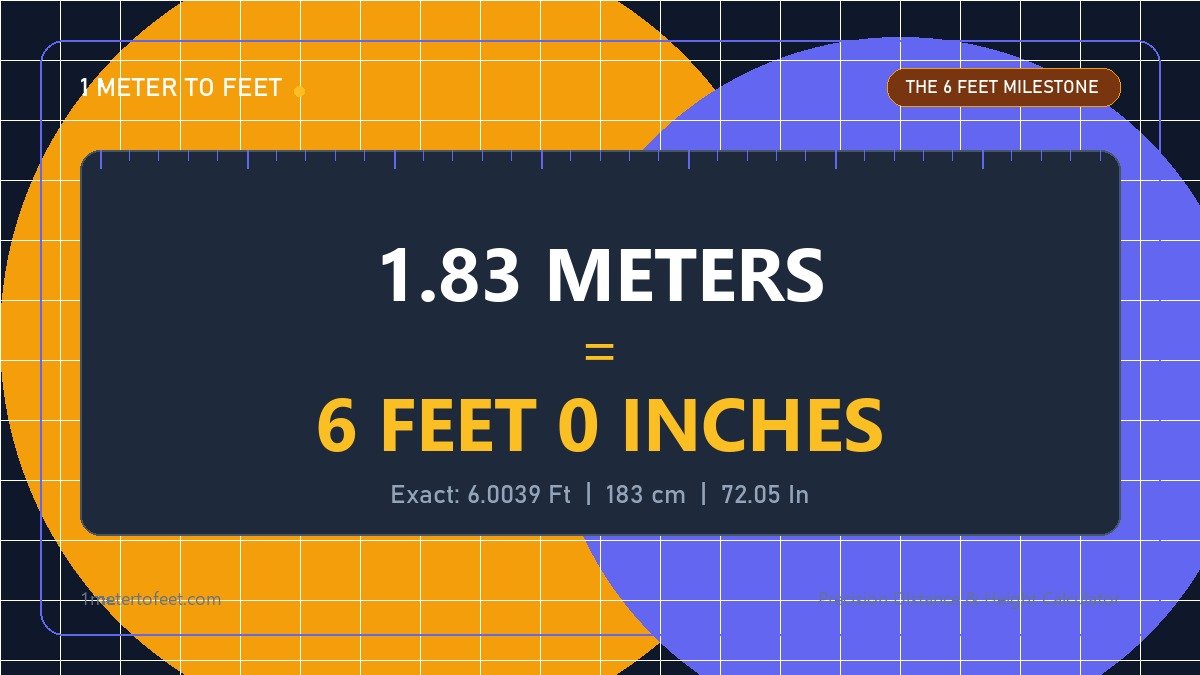
1.83 meters is equal to 6.0039 feet, which converts on a standard tape measure or medical height scale to 6 feet and 0.05 inches (universally recognized across official documentation, sports drafts, and conversational profiles as the exact 6 feet 0 inches, or 6′ 0″ benchmark). In metric units, 1.83 meters equals exactly 183 centimeters, and in total imperial length, it measures 72.05 inches.
The mathematical equation used for this calculation is Feet = Meters × 3.28084. If you need to convert any other custom height or room measurement instantly, use our free meters to feet online calculator for immediate results.
Introduction
Converting 1.83 meters to feet is one of the most widely searched height queries across the globe. In countries adhering to the metric system, height measurements on international passports, driver licenses, gym memberships, and medical records are documented in meters or centimeters. In contrast, throughout North America, the United Kingdom, and international sports scouting organizations, stature is almost universally communicated in feet and inches.
A height of 1.83 meters represents what is widely recognized as the holy grail of height milestones: the coveted six-foot mark. Whether navigating athletic recruitment guidelines, personal fitness tracking, or dating preferences, reaching 1.83 meters officially crosses the 6-foot barrier. Below is an exhaustive breakdown of the mathematical derivation, tape-reading fractional inches, demographic statistics, mental math shortcuts, and detailed reference tables.
The Exact Mathematical Formula and Derivation
The relationship between the metric meter and the international imperial foot is defined by international treaty under the International Yard and Pound Agreement of 1959. This agreement legally standardized one international yard as exactly 0.9144 meters, establishing one foot as exactly 0.3048 meters.
Taking the reciprocal of 0.3048 meters yields the universal conversion factor:
Feet = Meters × 3.2808399
To convert any distance or height from meters into decimal feet, multiply the meter measurement by 3.2808399. For a broader mathematical breakdown of conversion formulas, you can also consult our comprehensive guide on how to convert meters to feet.
Step-by-Step Calculation for 1.83 Meters
Applying the official international constant directly to 1.83 meters yields:
Feet = 1.83 × 3.280839895 = 6.0039370 ft
In real-world applications, this decimal value can be stated according to required precision standards:
For scientific research, ergonomics, and anthropometric studies, the complete value of 6.0039 feet is maintained.
For health clinics and medical fitness records, the measurement is recorded to two decimal places as 6.00 feet.
For general architectural drafting and clearance estimates, the figure is rounded to 6.0 feet.
Converting 1.83 Meters into Feet and Inches
Medical stadiometers and construction measuring tapes throughout North America do not show decimal feet. Instead, they divide measurements into whole feet, whole inches, and fractional divisions such as sixteenths or eighths of an inch.
To convert 6.0039 feet into a tape-readable format, first separate the whole number from the decimal. The whole integer represents 6 whole feet.
Next, take the remaining decimal fraction (0.003937 ft) and multiply it by 12, because there are 12 inches in a single foot:
0.003937 × 12 = 0.0472 inches
This calculation reveals that 1.83 meters equals 6 feet and less than five-hundredths of an inch. Because 0.047 inches is less than a millimeter, it is virtually imperceptible on any physical measuring tape.
Therefore, on a doctor’s stadiometer or standard wall chart, 1.83 meters reads cleanly as 6 feet 0 inches (6′ 0″).
Human Height Demographics: Is 1.83 Meters Considered Tall?
Analyzing 1.83 meters (6′ 0″) through international growth studies and demographic percentiles offers fascinating perspective on human stature:
For adult males globally, 1.83 meters places an individual well above the worldwide average male height of approximately 1.75 meters (5′ 9″). In the United States and the United Kingdom, standing 1.83 meters places a man in approximately the 82nd to 85th percentile, meaning he is taller than roughly 82 to 85 percent of the adult male population. For a direct comparison with the global male baseline, you can inspect our detailed 1.75 meters to feet conversion guide.
For adult females globally, where the worldwide average female height centers around 1.65 meters (5′ 5″), a woman standing 1.83 meters tall sits well above the 99.5th percentile, a stature prominently seen in Olympic volleyball, basketball, and runway modeling.
In athletic scouting and modeling requirements, 1.83 meters is considered the prime baseline for high-visibility roles and competitive sports drafts. For nearby tall athletic benchmarks, explore our 1.85 meters to feet height guide.
In retail apparel sizing, individuals measuring 1.83 meters typically wear Large (L) tops and require trouser inseams measuring between 32 and 34 inches.
Quick Mental Math Technique
When you need to estimate 1.83 meters without access to a digital calculator, you can rely on the quick factor of 3.28.
First, multiply 1.83 by 3 to reach 5.49. Then calculate roughly a quarter of two, which adds approximately 0.51. Summing 5.49 and 0.51 provides 6.00 feet.
Alternatively, memorizing that 183 centimeters corresponds directly to 72 inches allows you to divide 72 by 12 to immediately arrive at 6 feet 0 inches.
Reverse Conversion: Converting 6 Feet to Meters
To verify calculations or convert imperial measurements back into metric units, multiply the total foot measurement by 0.3048:
Meters = 6.0039 × 0.3048 = 1.8300 meters
Similarly, taking the total length of 72.05 inches and multiplying by 0.0254 returns exactly 1.83 meters.
Height and Stature Comparison Reference Table
The following reference table outlines nearby metric heights, decimal foot measurements, fractional tape increments, and total centimeters:
| Meters (m) | Centimeters (cm) | Decimal Feet (ft) | Feet & Inches | Total Inches (in) |
|---|---|---|---|---|
| 1.75 meters | 175 cm | 5.741 ft | 5 ft 8.9 in (5′ 9″) | 68.90 in |
| 1.78 meters | 178 cm | 5.840 ft | 5 ft 10.1 in | 70.08 in |
| 1.80 meters | 180 cm | 5.905 ft | 5 ft 10.9 in (5′ 11″) | 70.87 in |
| 1.82 meters | 182 cm | 5.971 ft | 5 ft 11.7 in | 71.65 in |
| 1.83 meters | 183 cm | 6.004 ft | 6 ft 0.0 in (6′ 0″) | 72.05 in |
| 1.85 meters | 185 cm | 6.070 ft | 6 ft 0.8 in (6′ 1″) | 72.83 in |
| 1.88 meters | 188 cm | 6.168 ft | 6 ft 2.0 in (6′ 2″) | 74.02 in |
| 1.90 meters | 190 cm | 6.234 ft | 6 ft 2.8 in (6′ 3″) | 74.80 in |
Frequently Asked Questions
Is 1.83 meters exactly 6 feet?
Yes. 1.83 meters equals 6.0039 feet, which translates to 6 feet and 0.05 inches. Because the difference is less than five-hundredths of an inch, 1.83 meters is considered the exact metric equivalent of 6 feet tall.
How many centimeters are in 6 feet?
Because one foot equals 30.48 centimeters, multiplying 6 by 30.48 gives 182.88 centimeters, which standardly rounds to 183 centimeters.
How many total inches is 1.83 meters?
Multiplying 1.83 meters by 39.3701 yields approximately 72.05 inches, matching the 72 inches found in exactly 6 feet.
What percentage of men are 1.83m or taller?
In the United States and the United Kingdom, approximately 15 to 18 percent of adult men reach or exceed 1.83 meters (6 feet) in height.
What size clothes correspond to 1.83m?
In standard retail apparel across North America and Europe, individuals measuring 1.83 meters typically wear Large (L) tops and trouser inseams measuring between 32 and 34 inches.
Explore Additional Measurement Conversions
To calculate other metric to imperial values or inspect complete height and distance datasets, explore our full directory of meter to feet conversion charts.