
Quick Answer Summary
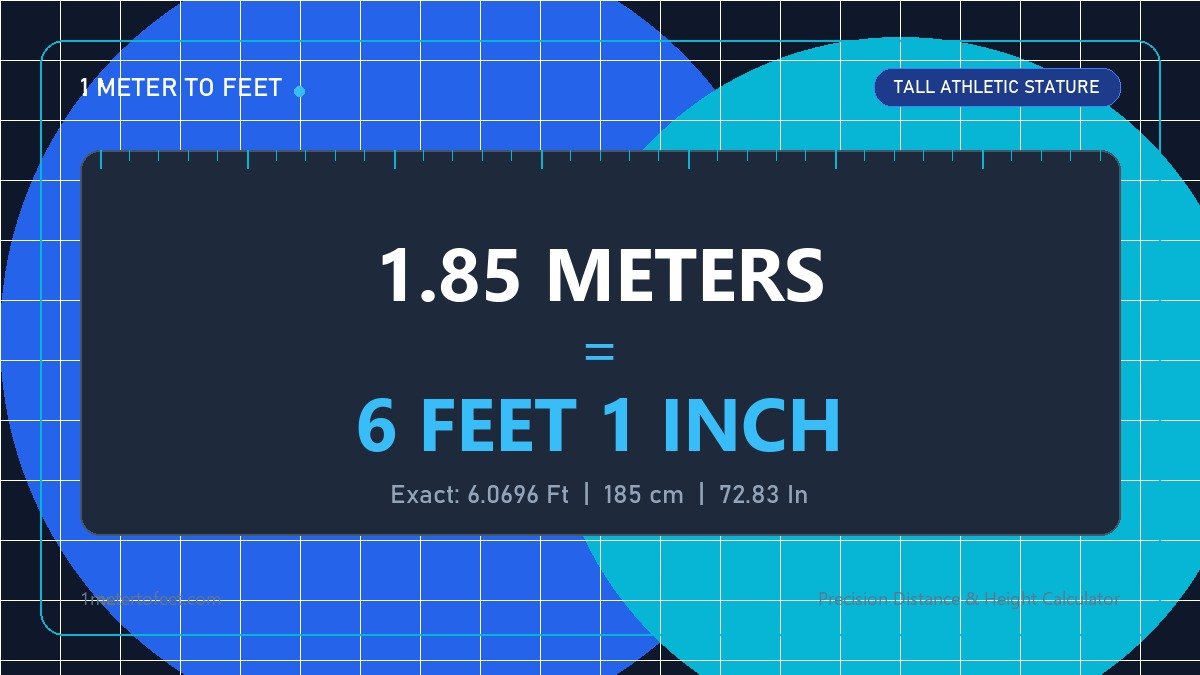
1.85 meters is equal to 6.0696 feet, which converts on a standard tape measure or medical height scale to 6 feet and 0.83 inches (commonly rounded on official identification and conversational profiles to 6 feet 1 inch, or 6′ 0 13/16″). In metric units, 1.85 meters equals exactly 185 centimeters, and in total imperial length, it measures 72.83 inches.
The mathematical equation used for this calculation is Feet = Meters × 3.28084. If you need to convert any custom height, distance, or room dimension instantly, use our free meters to feet online calculator for immediate results.
Introduction
Converting 1.85 meters into imperial feet and inches is one of the most common measurement inquiries worldwide. In metric-based nations, personal height on international passports, driver licenses, gym memberships, and medical records is recorded in meters or centimeters. Conversely, in the United States, Canada, the United Kingdom, and international sports scouting leagues, human height is almost exclusively stated in feet and inches.
A height of 1.85 meters represents a prestigious physical benchmark. Often characterized as the gold standard for tall athletic stature, it is frequently referenced in professional sports drafts, fashion modeling requirements, and celebrity demographic profiles. Below is an exhaustive breakdown of the mathematical derivation, tape-reading fractional inches, demographic statistics, mental math shortcuts, and detailed reference tables.
The Exact Mathematical Formula and Derivation
The relationship between the metric meter and the international imperial foot is defined by international treaty under the International Yard and Pound Agreement of 1959. This agreement legally standardized one international yard as exactly 0.9144 meters, making one foot equal to exactly 0.3048 meters.
Taking the reciprocal of 0.3048 meters yields the universal conversion factor:
Feet = Meters × 3.2808399
To convert any distance or height from meters into decimal feet, multiply the meter measurement by 3.2808399. If you want to review the full mathematical proof and historical background, explore our detailed guide on how to convert meters to feet.
Step-by-Step Calculation for 1.85 Meters
Applying the official international constant directly to 1.85 meters yields:
Feet = 1.85 × 3.280839895 = 6.0695538 ft
In real-world applications, this decimal value can be stated according to required precision standards:
For scientific research, ergonomics, and biomechanical modeling, the complete value of 6.0696 feet is preserved.
For medical clinics and athletic draft cards, the measurement is recorded to two decimal places as 6.07 feet.
For rough architectural clearance and general drafting, the figure is rounded to 6.1 feet.
Converting 1.85 Meters into Feet and Inches
Medical stadiometers and construction measuring tapes throughout North America do not show decimal feet. Instead, they divide measurements into whole feet, whole inches, and fractional divisions such as sixteenths or eighths of an inch.
To convert 6.0696 feet into a tape-readable format, first separate the whole number from the decimal. The whole integer represents 6 whole feet.
Next, take the remaining decimal fraction (0.069554 ft) and multiply it by 12, because there are 12 inches in a single foot:
0.069554 × 12 = 0.8346 inches
This calculation reveals that 1.85 meters equals 6 feet and approximately 0.83 inches.
Finally, multiply the remaining decimal of an inch by 16 to determine the nearest 16th of an inch. Because 0.8346 × 16 = 13.35, it rounds to 13/16 of an inch.
Therefore, on a physical measuring tape, 1.85 meters reads as 6 feet 0 and 13/16 inches. Because this measurement is less than two-tenths of an inch away from 6 feet 1 inch, it is universally documented on government identification, modeling resumes, and driver licenses as 6 feet 1 inch (6′ 1″).
Human Height Demographics: Is 1.85 Meters Considered Tall?
Analyzing 1.85 meters (6′ 1″) through international growth studies and demographic percentiles offers fascinating perspective on human stature:
For adult males globally, 1.85 meters places an individual well above the worldwide average male height of approximately 1.75 meters (5′ 9″). In North America and the United Kingdom, standing 1.85 meters places a man in approximately the 85th to 90th percentile, meaning he is taller than roughly 85 to 90 percent of the adult male population. For a direct comparison with the global male baseline, you can inspect our detailed 1.75 meters to feet conversion guide.
For adult females globally, where the worldwide average female height is approximately 1.65 meters (5′ 5″), a woman standing 1.85 meters tall sits well above the 99th percentile. This exceptional stature is predominantly seen among elite professional athletes in volleyball, basketball, and international high-fashion runway modeling. To compare with average female benchmarks, see our 1.65 meters to feet height guide.
In celebrity and public figure profiles, 1.85 meters is a widely celebrated stature shared by prominent actors and statesmen including Henry Cavill, Barack Obama, Ryan Gosling, and Chris Evans.
In apparel and retail sizing, individuals measuring 1.85 meters typically wear Large (L) or Extra Large (XL) tops and require trouser inseams measuring between 32 and 34 inches.
Quick Mental Math Technique
When you need to estimate 1.85 meters without access to a digital calculator, you can rely on the quick factor of 3.28.
First, multiply 1.85 by 3 to reach 5.55. Then calculate roughly a third of 1.5, which adds approximately 0.52. Summing 5.55 and 0.52 provides 6.07 feet.
Alternatively, memorizing that 180 centimeters equals roughly 5 feet 11 inches allows you to add the additional 5 centimeters (roughly 2 inches) to immediately conclude that 185 cm corresponds to 6 feet 1 inch.
Reverse Conversion: Converting 6.0696 Feet to Meters
To verify calculations or convert imperial measurements back into metric units, multiply the total foot measurement by 0.3048:
Meters = 6.0696 × 0.3048 = 1.8500 meters
Similarly, taking the total length of 72.83 inches and multiplying by 0.0254 returns exactly 1.85 meters.
Height and Stature Comparison Reference Table
The following reference table outlines nearby metric heights, decimal foot measurements, fractional tape increments, and total centimeters:
| Meters (m) | Centimeters (cm) | Decimal Feet (ft) | Feet & Inches | Total Inches (in) |
|---|---|---|---|---|
| 1.75 meters | 175 cm | 5.741 ft | 5 ft 8.9 in (5′ 9″) | 68.90 in |
| 1.78 meters | 178 cm | 5.840 ft | 5 ft 10.1 in | 70.08 in |
| 1.80 meters | 180 cm | 5.905 ft | 5 ft 10.9 in (5′ 11″) | 70.87 in |
| 1.82 meters | 182 cm | 5.971 ft | 5 ft 11.7 in | 71.65 in |
| 1.85 meters | 185 cm | 6.070 ft | 6 ft 0.8 in (6′ 1″) | 72.83 in |
| 1.88 meters | 188 cm | 6.168 ft | 6 ft 2.0 in (6′ 2″) | 74.02 in |
| 1.90 meters | 190 cm | 6.234 ft | 6 ft 2.8 in (6′ 3″) | 74.80 in |
| 1.95 meters | 195 cm | 6.398 ft | 6 ft 4.8 in (6′ 5″) | 76.77 in |
Frequently Asked Questions
How tall is 1.85 meters in feet and inches?
A height of 1.85 meters is equal to 6 feet and 0.83 inches, which is standardly rounded to 6 feet 1 inch on government identification, driver licenses, and sports scouting reports.
Is 1.85 meters equal to 6 feet or 6 feet 1 inch?
Because 1.85 meters equals 6.0696 decimal feet, the remaining 0.0696 feet equals 0.83 inches (over 13/16th of an inch). This places 1.85 meters just 0.17 inches shy of exactly 6 feet 1 inch, making 6′ 1″ the standard conversational and official figure.
How many centimeters are in 1.85 meters?
There are exactly 100 centimeters in one meter, which means 1.85 meters equals exactly 185 centimeters.
What is 1.85 meters converted to total inches?
Multiplying 1.85 meters by 39.3701 yields approximately 72.83 inches in total imperial height.
What door clearance does a person measuring 1.85m have?
Standard architectural residential interior doors measure 6 feet 8 inches (approximately 2.03 meters) in height. An individual standing 1.85 meters tall enjoys approximately 7 inches of head clearance beneath standard doorways.
Explore Additional Measurement Conversions
To calculate other metric to imperial values or inspect complete height and distance datasets, explore our full directory of meter to feet conversion charts.