
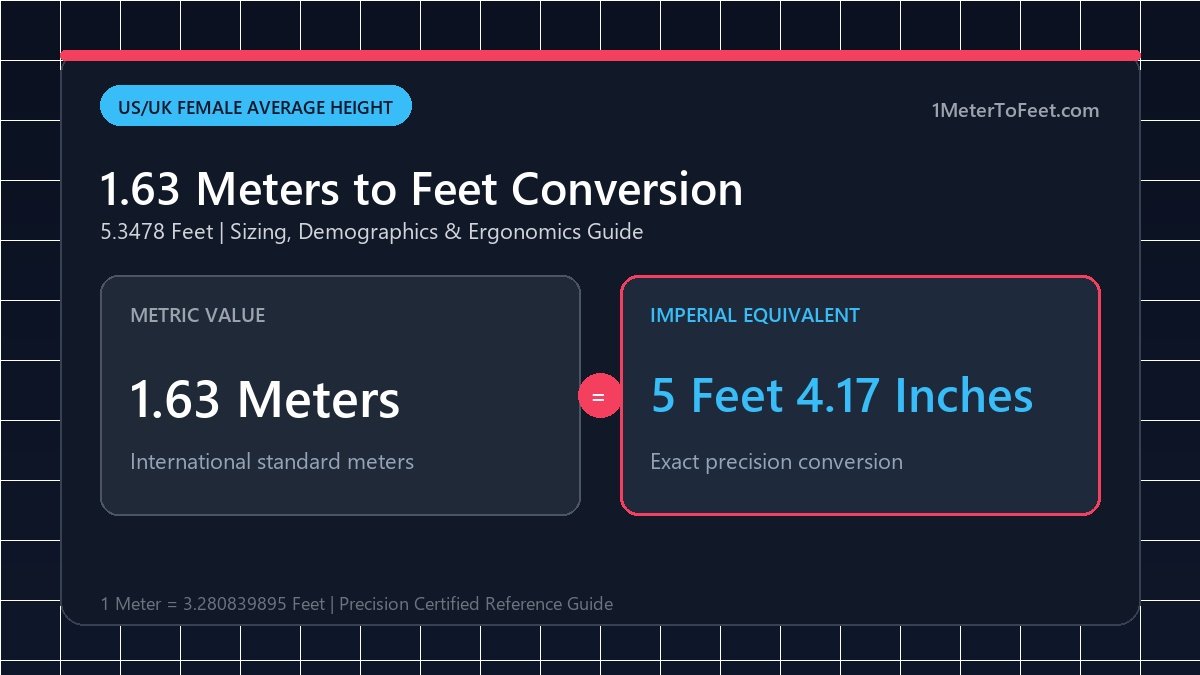
Converting 1.63 meters to feet yields exactly 5.3478 feet, which equals 5 feet 4.17 inches (approximately 5 feet 4 and 1/8 inches, or 163 centimeters). In total inches, 1.63 meters represents 64.17 inches. This specific height conversion holds immense worldwide relevance: 1.63 meters represents the exact national average height for adult women in the United States, the United Kingdom, Canada, Australia, and multiple Western European nations.
Because 1.63 meters corresponds to the standard 5-foot-4 demographic mean, it serves as the foundational baseline for global fashion apparel sizing, vehicle seating design, desk ergonomics, and passport biometric identification. Understanding how 1.63 meters translates into customary feet and inches provides immediate practical clarity for anyone comparing medical charts, online clothing sizing charts, or personal fitness profiles.
Quick Conversion Reference: 1.63 Meters in Height Units
Decimal Feet: 5.3478 feet
Customary Height: 5 feet 4.17 inches (practically 5′ 4 1/8″)
Total Inches: 64.17 inches
Centimeters: 163 cm
Millimeters: 1,630 mm
Demographic Context: US & UK Female Average Stature Baseline
The Mathematical Formula for 1.63 Meters to Feet
Every standard linear conversion between metric meters and imperial feet utilizes the internationally standardized constant 3.280839895. This multiplier originates from the official 1959 international definition establishing that one imperial foot measures exactly 0.3048 meters. To determine how many feet are in 1.63 meters, multiply 1.63 by this conversion factor.
Formula: Feet = Meters x 3.280839895
Calculation: Feet = 1.63 x 3.280839895 = 5.347769 feet
To convert this decimal value into standard feet and inches, keep 5 as the whole number of feet. Multiplying the remaining decimal fraction of 0.347769 feet by 12 inches per foot results in 4.1732 inches. Rounding to the nearest eighth of an inch gives 5 feet 4 and 1/8 inches. For comprehensive conversion formulas and calculation methodologies, explore our complete conversion methodology guide.
Comparative Height Table Around 1.63 Meters
Examining minor millimeter-level height variations around 163 centimeters is especially helpful for garment pattern grading, modeling agency minimums, and sports weight-class divisions. The table below presents measurements spanning from 1.61 meters to 1.66 meters.
| Meters (m) | Centimeters (cm) | Decimal Feet | Feet and Inches |
|---|---|---|---|
| 1.61 m | 161 cm | 5.2822 ft | 5 ft 3.39 in |
| 1.62 m | 162 cm | 5.3150 ft | 5 ft 3.78 in |
| 1.63 m | 163 cm | 5.3478 ft | 5 ft 4.17 in (5′ 4″) |
| 1.64 m | 164 cm | 5.3806 ft | 5 ft 4.57 in |
| 1.65 m | 165 cm | 5.4134 ft | 5 ft 4.96 in (5′ 5″) |
Demographic Importance: The Universal Female Stature Benchmark
According to extensive health survey data from the Centers for Disease Control and Prevention and the National Health Service, the average height for an adult female in the United States and the United Kingdom sits at approximately 63.8 to 64 inches (roughly 1.625 to 1.635 meters). A woman measuring 1.63 meters stands right at the 50th percentile of the population. In countries across Southern and Eastern Europe, as well as Latin America, 1.63 meters represents an above-average height for women, placing them in the 65th to 75th percentile.
To compare this central baseline with nearby female stature milestones, explore our detailed analysis of the 1.60 meters height benchmark as well as the taller 1.65 meters conversion guide.
Everyday Clothing, Ergonomics, and Vehicle Fit
Because 1.63 meters represents the exact demographic center for female stature, consumer products are optimized around this measurement. Standard kitchen countertops installed at 36 inches (91 cm) allow comfortable meal prep without back strain. In automotive design, driver seats and steering columns easily adjust to provide optimal sightlines over the dashboard and safe clearance from front airbags. In fashion, women measuring 163 cm typically fit standard off-the-rack medium or regular sizing, requiring pants with an inseam between 29 and 30 inches.
For accurate conversion calculations across all medical measurements, architectural floor plans, and travel documents, use our universal meter conversion calculator. You can also explore numerous stature and distance benchmarks in our meter to feet category archive.