
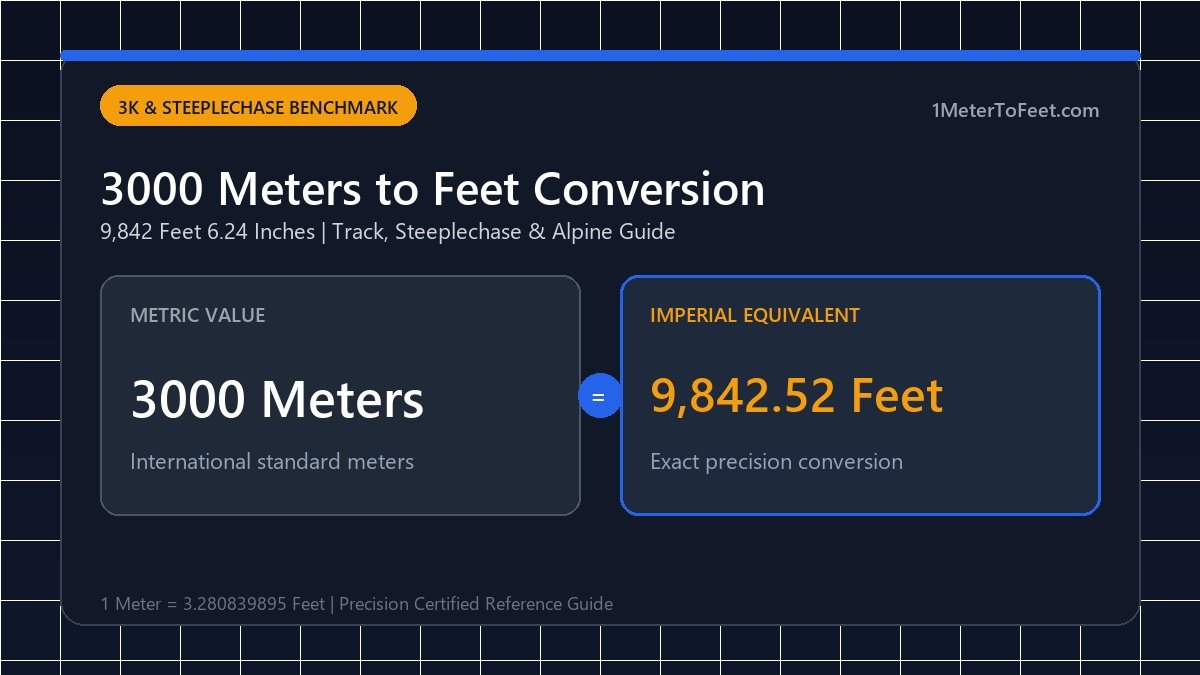
Converting 3000 meters to feet gives exactly 9,842.52 feet, which corresponds to 9,842 feet and 6.24 inches. In terms of larger geographic and sports distance units, 3000 meters equals precisely 3 kilometers, approximately 1.86411 miles, or 3,280.84 yards. The three-thousand-meter mark represents an iconic milestone across global athletics, serving as the official Olympic distance for the 3000-meter steeplechase, a core distance in indoor track championships, and a standard mid-distance threshold in international racing.
In physical geography and environmental topography, 3000 meters (roughly 9,843 feet) marks a monumental altitude boundary. In mountain ranges such as the European Alps, the Rocky Mountains, and the Andes, reaching 3,000 meters puts travelers right on the edge of the ten-thousand-foot mark, where atmospheric air pressure drops to roughly 70 percent of sea level and permanent snow lines begin to form. Understanding this conversion with mathematical precision provides essential context for runners evaluating split times, hikers assessing elevation gains, and surveyors calculating infrastructure grades.
Quick Conversion Reference: 3000 Meters in Imperial Units
Decimal Feet: 9,842.52 feet (rounded to two decimal places)
Feet and Inches: 9,842 feet 6.24 inches (roughly 9,842 feet 6 1/4 inches)
Total Inches: 118,110.24 inches
Total Yards: 3,280.84 yards
Total Miles: 1.86411 miles
Scientific Notation: 9.84252 x 10^3 feet
The Mathematical Formula for 3000 Meters to Feet
The universal conversion ratio between metric meters and imperial feet is 3.280839895013123. This mathematical constant originates from the 1959 international standards agreement, which legally defined one imperial foot as exactly 0.3048 meters. To determine the number of feet in 3000 meters, you multiply three thousand by this standardized multiplier.
Formula: Feet = Meters x 3.280839895
Calculation: Feet = 3000 x 3.280839895 = 9,842.519685 feet
To express this decimal calculation in customary feet and inches, keep 9,842 as the integer feet. Multiplying the remaining fractional portion of 0.519685 feet by 12 inches per foot produces 6.2362 inches, which rounds cleanly to 6.24 inches (or approximately 6 and 1/4 inches). To examine foundational linear derivation principles, review our complete conversion methodology guide.
Detailed Conversion Table Around 3000 Meters
Athletes planning pacing splits, trail hikers mapping alpine pass ascents, and civil engineers measuring drainage corridors frequently require intermediate values around three kilometers. The table below outlines adjacent metric benchmarks alongside their exact decimal feet and customary imperial equivalents.
| Meters (m) | Decimal Feet (ft) | Feet and Inches | Application & Context |
|---|---|---|---|
| 2,800 m | 9,186.35 ft | 9,186 ft 4.22 in | High mountain hut elevation threshold |
| 2,900 m | 9,514.44 ft | 9,514 ft 5.23 in | Penultimate lap bell in 3K track race |
| 3,000 m | 9,842.52 ft | 9,842 ft 6.24 in | Olympic 3000m steeplechase & 3K race |
| 3,100 m | 10,170.60 ft | 10,170 ft 7.25 in | Ten-thousand-foot elevation crossover |
| 3,200 m | 10,498.69 ft | 10,498 ft 8.26 in | High altitude glacier ski station |
Athletic Significance: 7.5 Laps and the Olympic Steeplechase
In track athletics, running 3000 meters requires completing seven and a half full laps around a regulation 400-meter outdoor track. In the Olympic 3000-meter steeplechase, competitors must clear 28 solid wooden barriers and seven water jumps over this 9,843-foot distance. Elite male distance runners complete the flat 3000-meter race in under 7 minutes and 25 seconds, averaging under 4 minutes per mile throughout the entire contest. World-class female steeplechase runners conquer the barriers and water hazards in under 8 minutes and 55 seconds.
Coaches structuring distance progression often bridge the aerobic threshold gap between our 2000 meters guide and the premier road benchmark outlined in the 5000 meters distance guide.
Alpine Geography, Tree Lines, and Oxygen Density
In geography and environmental physiology, 3000 meters marks the definitive boundary into high-altitude terrain. At roughly 9,843 feet above sea level, effective oxygen levels drop noticeably as barometric pressure decreases to around 70 kilopascals. In temperate zones worldwide, the alpine tree line terminates near this elevation, giving way to rock scree, permanent glacial fields, and hardy alpine tundra. Mountaineering guidelines recommend ascending gradually above 3,000 meters to ensure proper physiological acclimatization.
For immediate conversion of any linear metric measurement across civil engineering, athletic pacing, and outdoor trekking, explore our universal conversion calculator. To review additional mid-distance and altitude articles, browse our meter to feet category archive.