
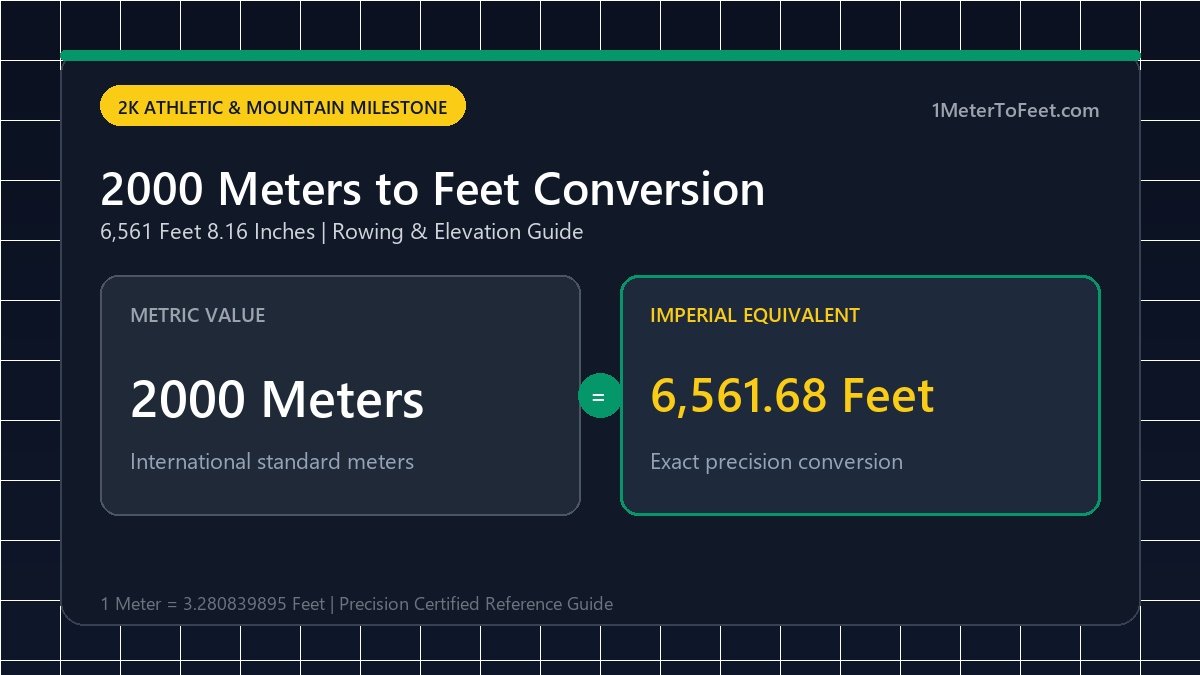
Converting 2000 meters to feet gives exactly 6,561.68 feet, which corresponds to 6,561 feet and 8.16 inches. In terms of larger geographic and sports units, 2000 meters equals precisely 2 kilometers, approximately 1.24274 miles, or 2,187.23 yards. The two-thousand-meter distance holds exceptional prominence across world sports: it serves as the official Olympic rowing race distance, the gold standard for indoor rowing ergometer testing, and a classic distance in track athletics such as the 2000-meter steeplechase.
In geographic and alpine topography, 2000 meters marks one of the most critical elevation thresholds on Earth. Across the European Alps and North American mountain ranges, 2000 meters (roughly 6,562 feet) defines the subalpine tree line and standard high mountain pass elevation. Converting 2000 meters to feet with precision enables sports scientists, rowers, mountain hikers, and civil engineers to accurately relate distance, split times, and topographic contours across metric and imperial systems.
Quick Conversion Reference: 2000 Meters in Imperial Units
Decimal Feet: 6,561.68 feet (rounded to two decimal places)
Feet and Inches: 6,561 feet 8.16 inches
Total Inches: 78,740.16 inches
Total Yards: 2,187.23 yards
Total Miles: 1.24274 miles
Scientific Notation: 6.56168 x 10^3 feet
The Mathematical Formula for 2000 Meters to Feet
The standard conversion factor connecting meters to feet is 3.280839895, which reflects the international standard where one imperial foot is legally established as exactly 0.3048 meters. To determine how many feet are in 2000 meters, multiply two thousand by this standardized multiplier.
Formula: Feet = Meters x 3.280839895
Calculation: Feet = 2000 x 3.280839895 = 6,561.67979 feet
To convert this decimal value into traditional feet and inches, keep 6,561 as whole feet. Taking the remaining decimal portion of 0.67979 feet and multiplying by 12 inches per foot produces 8.1575 inches, which rounds to 8.16 inches (or roughly 8 and 1/8 inches). For a comprehensive breakdown of decimal conversion formulas and foundational rules, visit our complete conversion methodology guide.
Detailed Conversion Table Around 2000 Meters
Rowing coaches analyzing 500-meter split intervals, runners pacing middle-distance efforts, and mountain trail climbers planning elevation gains regularly rely on incremental benchmarks around two kilometers. The table below details adjacent metric benchmarks alongside their exact decimal feet and customary imperial equivalents.
| Meters (m) | Decimal Feet (ft) | Feet and Inches | Application & Context |
|---|---|---|---|
| 1,800 m | 5,905.51 ft | 5,905 ft 6.14 in | Sprint finish threshold in 2K rowing |
| 1,900 m | 6,233.60 ft | 6,233 ft 7.15 in | Final 100m sprint buoy marker |
| 2,000 m | 6,561.68 ft | 6,561 ft 8.16 in | Olympic rowing course & subalpine contour |
| 2,100 m | 6,889.76 ft | 6,889 ft 9.17 in | High alpine pasture boundary |
| 2,200 m | 7,217.85 ft | 7,217 ft 10.18 in | Alpine ski resort mid-station altitude |
Athletic Significance: The Olympic Rowing Benchmark and Track Events
In competitive rowing, 2000 meters is the universally recognized race distance for all Olympic and World Rowing regattas. Rowers contest this 6,562-foot distance across six or eight buoyed lanes on calm freshwater lakes. Furthermore, indoor rowing ergometer fitness tests worldwide utilize the 2,000-meter trial as the primary benchmark of cardiovascular power and mental toughness. Elite heavyweight male rowers complete the 2000-meter ergometer test in under 5 minutes and 40 seconds, maintaining an average split pace under 1 minute and 25 seconds per 500 meters.
In track and field, 2000 meters equals exactly five full laps of a standard 400-meter outdoor track. It serves as an official World Athletics record distance and represents the traditional distance for the junior steeplechase. Coaches regularly compare middle-distance pacing between the 2000-meter threshold and our 1500 meters Olympic metric mile guide, alongside sprint endurance metrics detailed in the 800 meters guide.
Alpine Geography and Environmental Significance at 6,560 Feet
In environmental geography, 2000 meters marks the beginning of the true alpine ecological zone. At approximately 6,562 feet, deciduous forests give way entirely to hardy subalpine conifers, alpine meadows, and dwarf shrubs. Atmospheric pressure drops to approximately 78 kilopascals (about 78 percent of sea-level pressure), meaning visitors and endurance athletes begin to experience noticeable increases in ventilation and heart rate during aerobic exertion.
Whether you are calculating elevation contours for hiking expeditions, pacing your rowing ergometer splits, or reviewing architectural site elevations, our main conversion calculator provides rapid and dependable conversions for any distance. For an extensive collection of measurement guides, visit our comprehensive meter to feet category archive.