
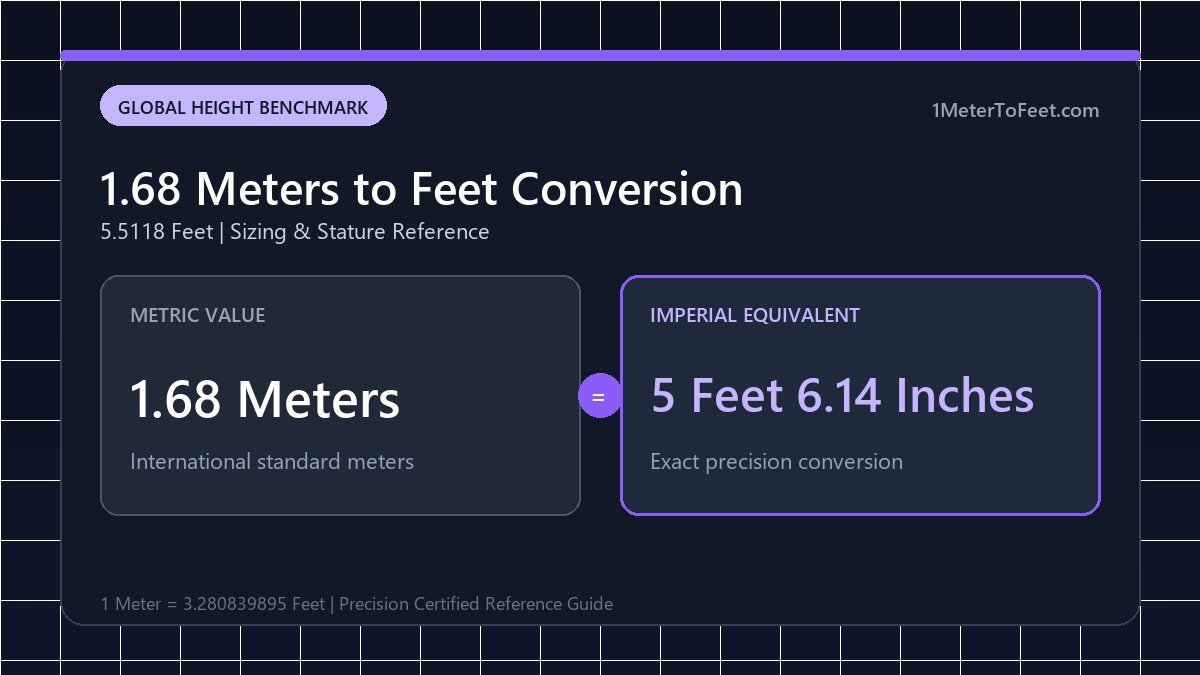
Converting 1.68 meters to feet yields exactly 5.5118 feet, which equals 5 feet 6.14 inches (or 168 centimeters). In total inches, 1.68 meters represents 66.14 inches. Stature measuring 1.68 meters represents one of the most prominent height benchmarks globally, serving as the average height for adult men in several Asian and South American countries and an above-average height for adult women in North America and Europe.
Whether you are calculating personal height for passport paperwork, determining ergonomic desk and workstation setup, or shopping for international clothing brands, converting 1.68 meters into customary feet and inches provides immediate practical clarity. Understanding how 1.68 meters translates into feet ensures that sizing charts, sports division categories, and fitness assessments are interpreted accurately.
Quick Conversion Reference: 1.68 Meters in Height Units
Decimal Feet: 5.5118 feet
Customary Height: 5 feet 6.14 inches (approximately 5′ 6 1/8″)
Total Inches: 66.14 inches
Centimeters: 168 cm
Millimeters: 1,680 mm
Fractional Approximation: 5 feet 6 and 1/8 inches
Step-by-Step Mathematical Formula: 1.68m to Feet
The standard formula for converting meters into imperial feet relies on the exact mathematical constant 3.280839895, which reflects the international standard where one foot equals exactly 0.3048 meters. Multiplying 1.68 meters by this ratio reveals the exact decimal foot measurement.
Formula: Feet = Meters x 3.280839895
Calculation: Feet = 1.68 x 3.280839895 = 5.511811 feet
To convert this decimal result into feet and inches, extract the whole number 5 as total feet. Then multiply the remaining 0.511811 fractional feet by 12 inches per foot, producing 6.1417 inches. Rounded to the nearest quarter of an inch, 1.68 meters is 5 feet 6 inches. For detailed mathematical derivations and reference conversion formulas, review our complete conversion methodology guide.
Comparative Table Around 1.68 Meters
Having a clear view of small incremental changes around 168 centimeters is particularly helpful for athletic weight-class profiling, fashion modeling requirements, and garment manufacturing. The table below presents measurements from 1.65 meters to 1.70 meters.
| Meters (m) | Centimeters (cm) | Decimal Feet | Feet and Inches |
|---|---|---|---|
| 1.65 m | 165 cm | 5.4134 ft | 5 ft 4.96 in |
| 1.67 m | 167 cm | 5.4790 ft | 5 ft 5.75 in |
| 1.68 m | 168 cm | 5.5118 ft | 5 ft 6.14 in |
| 1.69 m | 169 cm | 5.5446 ft | 5 ft 6.54 in |
| 1.70 m | 170 cm | 5.5774 ft | 5 ft 6.93 in |
Demographic Context: How Common Is 1.68 Meters?
Standing at 1.68 meters places an individual in an interesting demographic position. For women globally, 1.68 meters (5 feet 6 inches) is considered tall, sitting in roughly the 75th to 80th percentile across the United States, Canada, and the United Kingdom where the average female height is approximately 1.63 meters (5 feet 4 inches). In fashion, 1.68 meters is often considered the entry threshold for commercial catalog modeling.
For men, 1.68 meters is slightly below the Western average of 1.77 meters, but matches the average male stature in several Latin American, Southeast Asian, and Mediterranean populations. In athletic disciplines like combat sports, gymnastics, soccer, and middle-distance running, athletes standing 5 feet 6 inches often possess exceptional power-to-weight ratios, rapid acceleration, and a low center of gravity that delivers superior agility. To compare this with nearby benchmarks, see our 1.65 meters guide and the 1.72 meters height profile.
Everyday Living and Ergonomic Guidelines
At 5 feet 6.14 inches, individuals interact smoothly with standard public and home furnishings. Most kitchen countertops designed at 36 inches (91 cm) in height and office desks set at 28 to 30 inches (71 to 76 cm) accommodate this stature with minimal need for custom footrests or specialized monitor risers. In ready-to-wear clothing, standard medium or small sizes fit well, typically paired with pants featuring a 30-inch inseam.
To convert any measurement instantly across metric and imperial systems, use our main conversion calculator, and browse our extensive collection of stature and distance benchmarks in the meter to feet category archive.